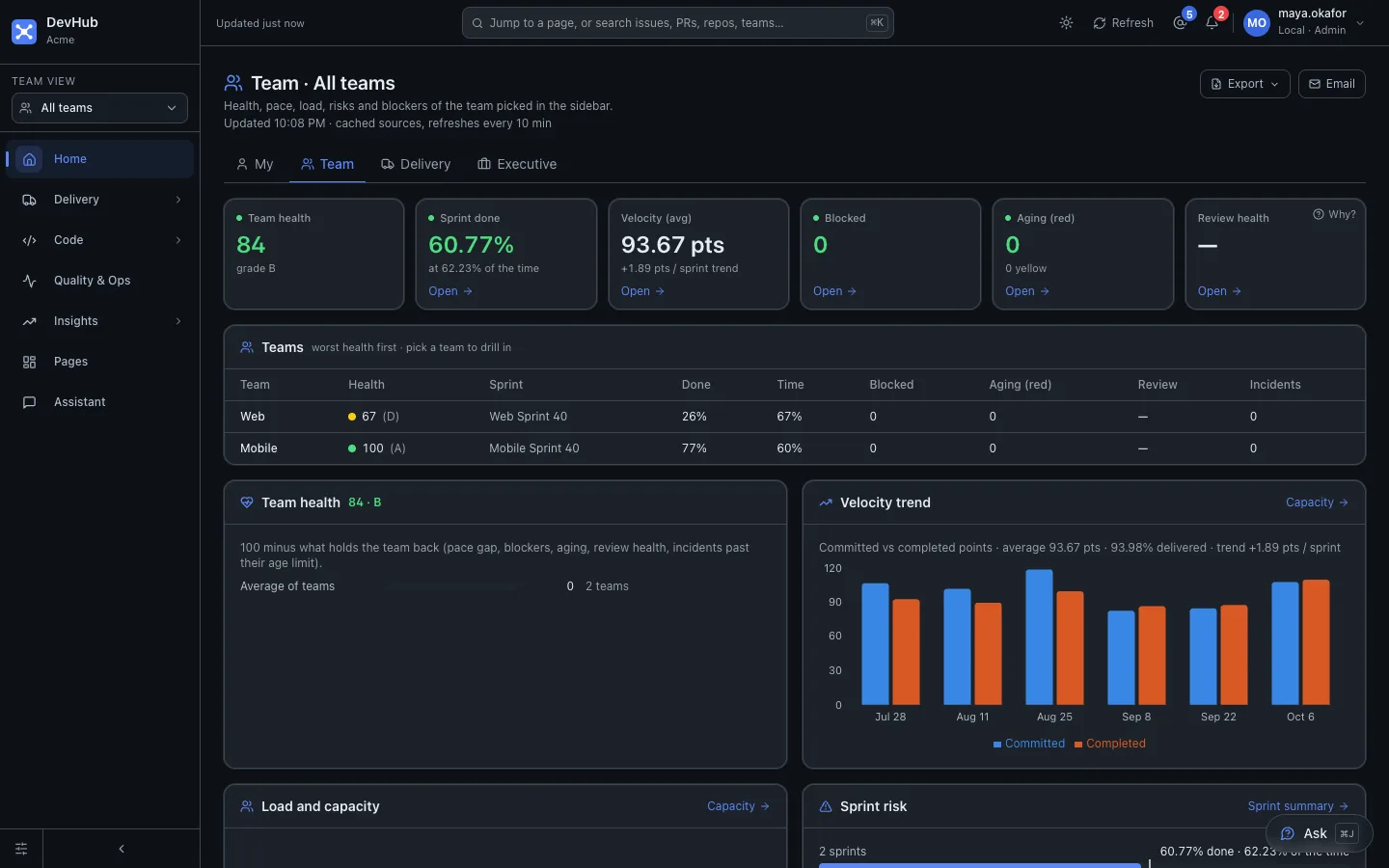
One pane of glass
for engineering teams.
Repos, pull requests, and sprints — unified — with an AI layer grounded in your real delivery data, not a chat widget bolted on top.
Your status lives in a dozen tabs.
GitHub or Azure DevOps for code. A separate board for sprints. A separate chat tool for asking a question about the codebase. Nobody has one place to look, so status goes stale and questions wait for whoever wrote the code to be online.
The category's existing answer — internal developer portals like Backstage — solves this, but the tooling itself becomes a second job. DevHub is the pane of glass, without the platform team.
Two views. One indexed system underneath.
DevHub does more than this under the hood — but these two are where teams actually feel the difference first.
Every open PR, across providers, in one queue.
Review queues, throughput, and check status — GitHub and Azure DevOps in the same list, not two browser tabs.
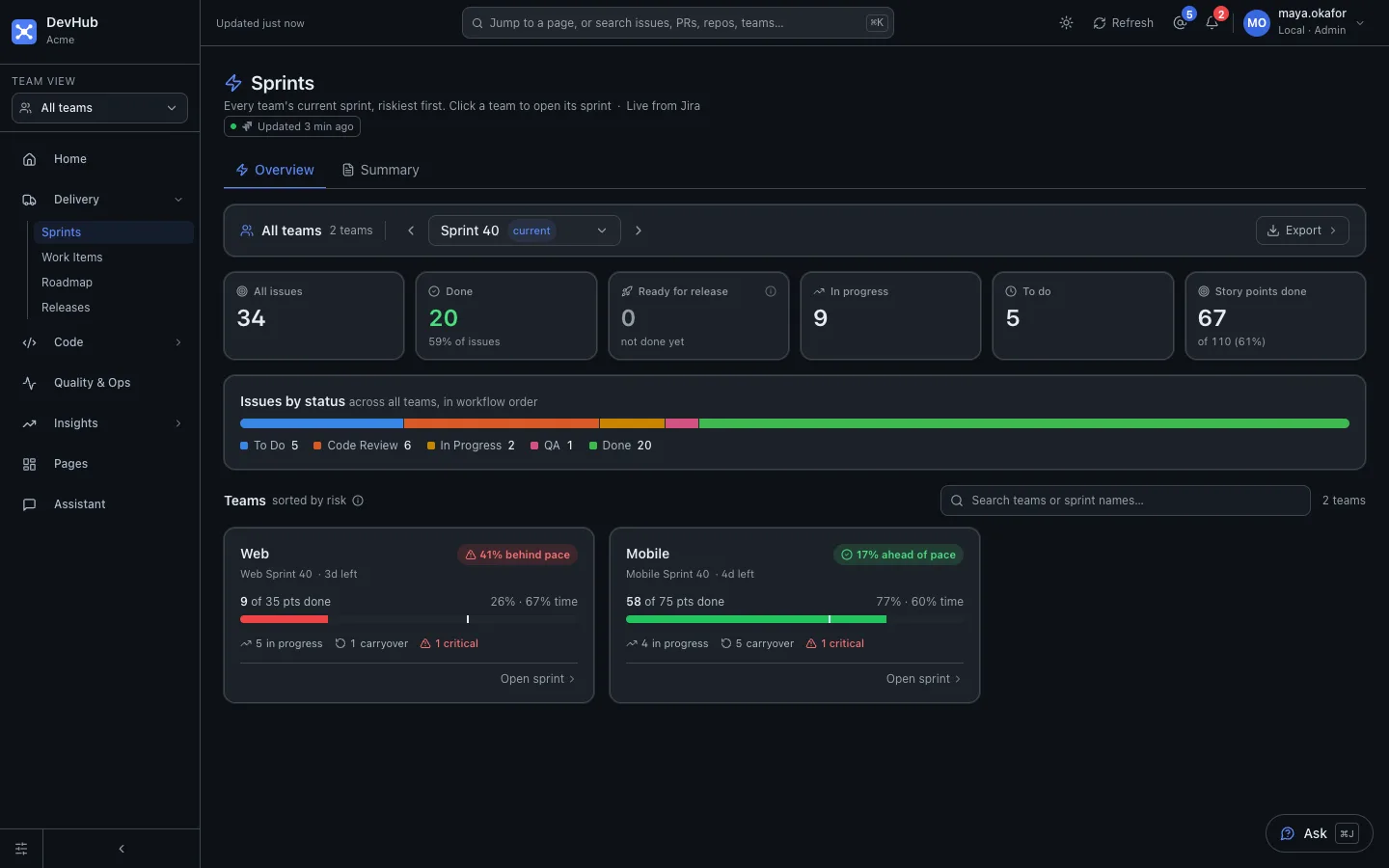
One board, whichever tracker each team actually uses.
Backlog through released, rolled up across teams — without forcing everyone onto the same ticketing tool first.
Ask your engineering org a question.
Get a grounded answer.
Yes — 100% of prod traffic since the 14:02 UTC deploy. Canary → 25% → 100%, no rollback triggers.
Two PRs touch the auth middleware with no new test coverage, and payments-service is 3 minor versions behind its last security patch.
Backstage-level control, without the six-month build.
Every number below is a public estimate, not a guarantee — the point is the shape of the tradeoff, not a precise quote.
Backstage
Free license — but real-world reports put first-year cost at $150k–$1.2M in platform-engineer time to stand up and maintain.
3–6 months to a usable catalog, ongoing team to keep it that way.
Cortex / Faros / Port
Roughly $25–60 per developer per month — priced for orgs north of 100–300 engineers.
Weeks to months of catalog/integration setup, per public case studies.
DevHub
Your infra cost only. No per-seat license.
Live against a real org same-day.
Run it in your cloud, or see it running in ours first.
Self-hosted
- ◦ Your infra, your Postgres, your rules
- ◦ Data never leaves your environment
- ◦ No per-seat license
Hosted walkthrough
- ◦ Pointed at a public org — no credentials needed
- ◦ Live in one call, no procurement cycle
- ◦ Same product, either path
Want to see it against a real org?
No procurement cycle to see it work — get in touch and I'll walk it through against a public GitHub org live.
Get in touch